

Show summary Hide summary
- Mario Tennis Fever as Nintendo’s boldest tennis experiment
- Adventure Mode, minigames and how long Fever really lasts
- Multiplayer chaos, couch battles and online potential
- Does Mario Tennis Fever justify the $70 game price?
- Where Mario Tennis Fever fits in your gaming library
- Key takeaways before you consider a purchase
- Is Mario Tennis Fever worth $70 for solo players?
- How does Mario Tennis Fever compare to Mario Tennis Aces?
- Is Mario Tennis Fever good for local multiplayer sessions?
- Does Mario Tennis Fever have enough content for long-term play?
- Should I buy Mario Tennis Fever or wait for a sale?
Volleys that curve like magic, rackets that set courts on fire, and 38 Nintendo icons packed into one Tennis game sound irresistible. Mario Tennis Fever feels like the ultimate fantasy for fans of video games and arcade sports. Yet the moment you see that $70 game price, the excitement starts to wobble.
Mario Tennis Fever as Nintendo’s boldest tennis experiment
Mario Tennis Fever arrives on Switch 2 positioned as the definitive Nintendo Tennis game, and from the first rally it makes that ambition obvious. Every character, from Mario and Peach to deeper cuts like Pauline and Waluigi, carries distinct movement, power and trick-shot tendencies that meaningfully alter your gaming experience. You feel the difference when a power-focused character dominates the baseline while a nimble one thrives at the net.
The new Fever Rackets define this title’s identity. Instead of being cosmetic skins, they behave almost like loadouts in competitive action games. Some rackets ignite the court and punish opponents who stand in burning zones. Others spawn doppelgangers that confuse shot prediction, or smear the ground with mud that slows movement. The resulting rallies feel less like standard Tennis and more like controlled chaos, echoing the item-driven unpredictability of Mario Kart without fully abandoning traditional scoring.
Top Apple HomeKit and Siri Gadgets to Enhance Your Smart Home in 2026
Google Relaunches Android 17 Beta 1 Shortly After Initial Pause
Why the court never feels the same twice
To understand why Fever stands out in the Mario Tennis lineage, you can look at how it layers variables. Court types subtly alter ball bounce and speed, but the real spice comes when Fever Rackets and special modes intersect. Imagine a clay-like arena already slowing shots, then a chaos-focused racket drops pinball bumpers that redirect the ball in surprising directions. Suddenly, a routine rally turns into a spatial puzzle where anticipation matters as much as reflexes.
This dynamic design rewards experimentation. A player like Lena, an avid Tennis game fan, might start with a balanced racket for standard matches, then gradually unlock wilder gear that suits party nights. Over time she learns that one particular racket pairs perfectly with doubles, because its court-wide effect supports a teammate’s aggressive playstyle. That slow discovery process gives Fever the feel of a deep fighting game wrapped in approachable Nintendo packaging.
Adventure Mode, minigames and how long Fever really lasts
Beyond exhibition matches, Mario Tennis Fever leans on its Adventure Mode to justify its premium price. Rather than a full RPG in the style of older handheld entries, it acts as an extended training ground stitched together with light narrative. Each chapter introduces tactical concepts such as zone control, timing riskier smashes, or reading your opponent’s meter before they unleash a Fever effect. Boss encounters then stress-test those skills with unusual court layouts and scripted hazards.
This structure benefits newcomers who might be overwhelmed by the sheer number of abilities. A player can treat Adventure Mode as a curated onboarding ramp, earning new rackets and cosmetic rewards while building muscle memory. At the same time, veterans will likely burn through the story more quickly, noticing that character progression remains shallow compared with classic RPG-style Mario sports titles, which may leave them wishing for deeper long-term hooks.
Party-friendly modes and the replay loop
Outside Adventure, the game spreads its content across side activities that lean into pure fun. Ring-shot challenges encourage precision placement by rewarding balls threaded through moving hoops. A pinball-inspired mode turns the court into a bouncing playground, where banking shots off bumpers becomes more important than outplaying an opponent positionally. Trial Towers stack increasingly harsh conditions and AI rivals to push experienced players toward mastery.
These modes support near-infinite replay if you enjoy chasing higher scores or competing with friends locally. Someone like Amir, who hosts weekly game nights, might rotate between standard doubles, ring modes and bumper courts to keep the room laughing. However, once you have sampled every variation, the structure becomes familiar, and that is where questions about long-term value relative to the $70 tag quietly surface.
Multiplayer chaos, couch battles and online potential
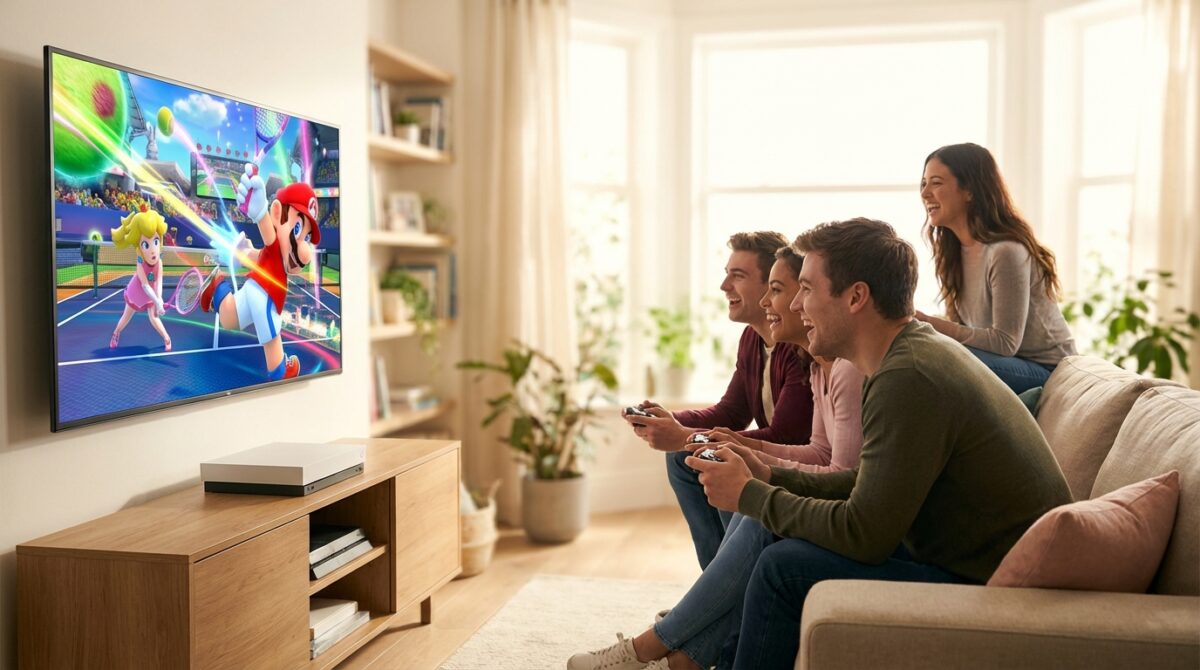
Fever’s design screams multiplayer from the ground up. Four-player doubles on a single screen showcase the best of the Switch 2’s horsepower and Nintendo’s party-game instincts. Visual clarity remains surprisingly strong even when rackets trigger overlapping Fever effects, and the higher resolution over the original Switch helps you track the ball through particle-heavy moments. For many players, this will be their definitive Mario Tennis memory: crowded couches, sudden comebacks, and the kind of shouted reactions only a tight rally can generate.
Local play also highlights how accessible the control scheme remains. A beginner can focus on basic shots and positioning while a more advanced friend manages trick shots and meter management. Over time, newcomers gradually absorb mechanics by osmosis. This shared skill growth mirrors successful competitive games, where the social context keeps people engaged longer than solo content might manage on its own.
Online play, balance concerns and competitive ceiling
The question many dedicated fans ask is whether Mario Tennis Fever can sustain a serious online scene. Balance will hinge on how Nintendo tunes the most disruptive Fever Rackets. If certain effects dominate high-level play, variety might shrink as players gravitate toward a narrow range of “optimal” builds. On the other hand, a healthy rotation of patches could keep the meta evolving and justify long-term engagement for ranked competitors.
Early commentary from outlets such as IGN’s review of Mario Tennis Fever suggests that the core mechanics feel responsive enough to support skillful competition, even when chaos erupts. Lag, matchmaking tools and seasonal incentives will determine whether ambitious players treat Fever as a serious hobby or a side distraction between larger releases. For now, the multiplayer foundation looks strong, but the community’s dedication will decide how high its competitive ceiling rises.
Does Mario Tennis Fever justify the $70 game price?
The most persistent tension around Fever centers on cost. At $70, it occupies the same bracket as expansive single-player adventures with dozens of hours of unique content. By comparison, this sports game focuses almost entirely on one activity: stylized Tennis. While the modes, characters and rackets offer breadth, the underlying loop remains consistent. After several evenings, some players report a sense of having “seen it all,” even if replayability technically remains high.
Value perception always depends on habits. A family that plays Mario Tennis every weekend for a year will extract far more from the purchase than a solo player who spends five hours in Adventure and moves on. Someone like Sofia, who divides her time between several Switch 2 titles, may hesitate when she realizes that the price equals or exceeds some multi-genre collections or deep narrative RPGs on the same system.
How Fever compares to other premium Nintendo releases
Context from other reviews underlines the dilemma. Analyses from places like CNET’s detailed Switch 2 coverage and broader gaming press often praise the feel of play yet question the pricing strategy. Compared to Mario Kart World or large-scale platformers on Switch 2, Fever resembles a focused side project, not a centerpiece of the generation. The phrase many critics use is “best-in-class Tennis, mid-tier value.”
From a practical standpoint, waiting for a sale becomes a rational choice unless you are deeply invested in the Mario Tennis brand or plan to feature it heavily on game nights. Over time, as the Switch 2 library grows and bundle deals appear, Fever will likely feel like a stronger proposition as part of a collection rather than a full-price impulse buy. The core lesson for players is clear: judge not only the quality of the experience, but how often you will realistically return to it.
Where Mario Tennis Fever fits in your gaming library
Thinking about Mario Tennis Fever as a long-term library piece rather than a must-buy launch-era showpiece may help resolve the price dilemma. For many Nintendo fans, it will eventually sit alongside Mario Kart and party titles as a dependable option when friends visit. The depth of the mechanics ensures that, even months later, you can rediscover strategies, try unexplored rackets, or introduce the game to someone completely new without it feeling stale.
The Switch 2’s catalogue is expanding with platformers, action adventures and experimental indies, so prioritization matters. If you crave narrative depth, Fever will not displace sprawling role-playing games. If you want mechanically tight, endlessly replayable action that shines in short bursts, it rises sharply on the list. Evaluating your habits honestly is the best way to decide whether to buy now, wait for discounts, or simply keep it on your radar for a future lull in big releases.
Key takeaways before you consider a purchase
Before committing, many players run through a quick mental checklist. Do you have a regular group interested in Couch multiplayer? Are you the type to master combo systems and hidden mechanics, or do you move quickly between new releases? How sensitive are you to game price compared with time invested? Mario Tennis Fever rewards those who answer positively to the first two questions.
For everyone else, tracking community impressions and patch notes over the coming months may be wise. If Nintendo expands the lineup of modes or tweaks progression to feel more generous, the overall package could age gracefully. By then, discounts will likely soften the financial impact. That timing could transform what currently feels like a slightly overpriced Tennis gem into a comfortable, no-brainer addition to your Switch 2 shelf.
- Fever offers the tightest Mario Tennis mechanics to date, with 38 distinctive characters.
- Fever Rackets introduce creative chaos that keeps matches unpredictable and fun.
- Adventure Mode teaches strategy effectively but stops short of full RPG depth.
- Local multiplayer shines, especially in doubles, for parties and family sessions.
- The $70 asking price feels high unless you plan heavy, long-term play.
Is Mario Tennis Fever worth $70 for solo players?
Solo players who mainly want a structured story may find the $70 price difficult to justify. Adventure Mode teaches mechanics and offers boss encounters, yet it does not provide the progression depth of large RPGs. If you rarely play local or online multiplayer, waiting for a discount is usually the smarter option.
How does Mario Tennis Fever compare to Mario Tennis Aces?
Fever expands on Aces with more characters, a wider variety of courts and the new Fever Rackets that dramatically alter each match. The core Tennis gameplay feels sharper and more responsive on Switch 2 hardware. However, players who already own Aces may see Fever as more of a refined upgrade than a completely new experience.
Is Mario Tennis Fever good for local multiplayer sessions?
Yes, Fever is particularly strong as a local multiplayer title. Four-player doubles with wild racket effects create constant surprises and loud reactions. The controls remain accessible for beginners, while advanced players can still exploit trick shots and meter management. It fits very well into game nights or family gatherings.
Does Mario Tennis Fever have enough content for long-term play?
Troubleshooting Frequent VPN Disconnections: Causes and Solutions
YouTube Music Introduces New Lyrics Restrictions for Free Tier Users
The game offers Adventure Mode, Trial Towers, unique minigames and extensive character-racket combinations. Mechanically, it supports long-term mastery, especially for competitive or social players. Perceived content depth depends on your tolerance for repetition, since all modes ultimately revolve around stylized Tennis rather than multiple sports.
Should I buy Mario Tennis Fever or wait for a sale?
If you are a dedicated Mario Tennis fan or run frequent multiplayer sessions, buying at launch can make sense because you will use the game extensively. If you play sporadically or focus on single-player epics, waiting for a discount or bundle is more reasonable. The core experience will remain strong even if you join later.