
Show summary Hide summary
- Mirrorless cameras leading the top cameras 2026 shortlist
- Creator-focused bodies and camera innovations for video-first users
- High-resolution and specialty models in the best cameras 2026
- Action cams, compacts, and portable photography gear 2026
- Choosing between sensor sizes and systems in camera reviews
- Practical checklist before investing in the latest camera technology
- Which sensor size is best among the top cameras 2026?
- Are DSLR cameras still worth considering against mirrorless cameras?
- How important is 8K video in camera releases 2026?
- Do action cameras replace mirrorless bodies for travel content?
- How do I stay updated on camera trends without getting overwhelmed?
Imagine unboxing a camera that predicts your subject, stabilizes your steps, and shoots cinema-grade video without complex rigs. That is the promise of the top cameras 2026, where AI autofocus, stacked sensors, and creator-first design finally converge into tools that feel almost telepathic.
Mirrorless cameras leading the top cameras 2026 shortlist
When your livelihood or passion revolves around images, mirrorless cameras have become the natural starting point. Their mix of compact bodies, interchangeable lenses, and cutting-edge sensors means the best cameras 2026 for most people sit in this category, not among older DSLR cameras. Brands like Sony, Canon, Nikon, Fujifilm, and Panasonic now pour nearly all serious R&D into mirrorless platforms.
Consider Alex, a content creator who alternates between street photography, travel vlogs, and short-form vertical video. A body like Canon’s R10, with its 24.2-megapixel APS-C sensor, 23 fps electronic bursts, and oversampled 4K 30p, lets Alex jump from stills to video with almost no compromise. The lack of in-body stabilization demands a bit more care or a gimbal, yet the fully articulating screen and Dual Pixel AF with subject recognition feel tailored for creators who need reliable focus more than anything else.
Top Fast Chargers to Power Your Devices in 2026
JLab Unveils Innovative Bluetooth Speaker That Transforms Into Giant Headphones
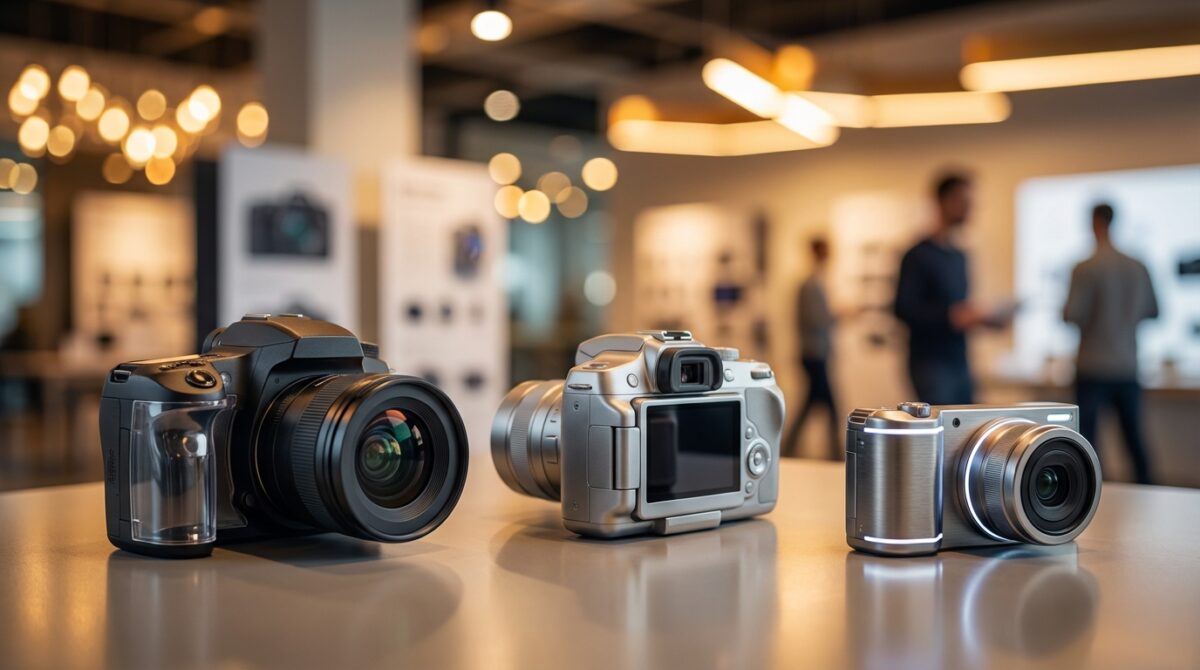
Flagship mirrorless bodies redefining photography gear 2026
Move up the range and you see why camera reviews keep calling 2025–2026 a sweet spot for hybrid shooters. Sony’s A7 V brings a partially stacked 33-megapixel sensor that reads out very quickly, which reduces rolling shutter wobble and boosts autofocus responsiveness. Photographers gain more dynamic range for flexible raw editing, while video shooters capture detailed 4K with fewer distortions when panning or tracking fast action.
Nikon’s Z6 III adopts a similar partially stacked idea, acting as a “mini Z8” for enthusiasts. It delivers 20 fps RAW bursts, 6K RAW up to 60 fps, and 4K 120p for slow motion. The trade-off is slightly lower resolution and compressed dynamic range compared with some rivals, yet sports and wildlife shooters appreciate the balance between speed and image quality. For many working professionals, this kind of compromise aligns better with daily assignments than ultra-high megapixel options.
Creator-focused bodies and camera innovations for video-first users
Vloggers and streamers judge cameras differently from traditional photographers. They want clean audio, reliable eye tracking, flattering color science, and minimal rolling shutter, sometimes more than sheer megapixels. This is where camera innovations in models like Sony’s ZV-E10 II and Canon’s EOS R6 III change what “best cameras 2026” means for a generation that publishes daily.
The ZV-E10 II uses a 26-megapixel APS-C sensor that reads faster than its predecessor, almost eliminating the jello effect when you pan. Supersampled 4K 30p from the full width and 4K 60p with a mild 1.1x crop make it versatile for both sit-down content and travel vlogging. Lack of an electronic viewfinder and mechanical shutter signals that Sony expects many owners to live in video mode, often framing with the flip screen and prioritizing log recording, LUT imports, and 10-bit color over traditional stills ergonomics.
High-end hybrids raising expectations for latest camera technology
Step into the full-frame tier and creator-focused hybrids look even more ambitious. Canon’s EOS R6 III, with its new 33-megapixel sensor, offers 7K RAW at 60 fps alongside rapid autofocus and improved in-body stabilization. For an independent filmmaker, that means oversampled 4K deliverables, strong low-light performance, and latitude for grading without jumping to much pricier cinema lines.
Panasonic’s Lumix S1 II targets filmmakers directly with 6K ProRes RAW up to 30 fps, open gate recording that uses the full sensor, and superb stabilization that smooths walking shots better than many gimbals. The price places it near higher-end competitors, yet for studios like the fictional “Neon Fold Films,” the built-in tools reduce rigging costs and setup time on smaller productions. In that sense, the camera becomes part of a larger trend where pro codecs, advanced stabilization, and flexible aspect ratios migrate down to relatively compact mirrorless bodies.
High-resolution and specialty models in the best cameras 2026
Not every photographer chases speed. Many value resolution and tonal nuance more than frame rate, especially in landscape, fashion, or commercial work. Among the top cameras 2026, this niche remains vibrant, with models like Sony’s A7R V and Hasselblad’s X2D II 100C pushing detail into territory that once belonged only to medium format film or large studio backs.
The A7R V packs a 61-megapixel sensor that still shoots at 10 fps, which is impressive for such a pixel-dense device. Landscape shooters benefit from huge prints and wide latitude when recovering highlights or shadows. The viewfinder ranks among the sharpest on the market, helping precise manual focus on tripods. Video features such as 8K and 10-bit recording exist, yet rolling shutter can be pronounced, so many users treat it as a stills-first tool with occasional video capability.
Medium format appeal and evolving camera trends
Hasselblad’s X2D II 100C, on the other hand, appeals to photographers who see gear as part of a slower, more deliberate practice. Its 100-megapixel medium format sensor suggests outstanding dynamic range and subtle color transitions, which portrait and art photographers value when aiming for museum-grade prints. Autofocus now rivals rivals from Fujifilm, fixing a long-standing criticism of previous generations.
For a studio like our fictional “Aurora Atelier,” this kind of body changes client impressions. The camera itself becomes a talking point, yet its real value lies in the files it produces. Paired with controlled lighting, the X2D II 100C captures skin tones and textiles in a way that smartphones or even many full-frame bodies struggle to match. As smartphone delays such as the reported iPhone 18 launch timeline shift extend the life of older phones, dedicated systems like these stand out even more for demanding visual work.
Action cams, compacts, and portable photography gear 2026
Not every project calls for a lens mount and large sensor. Some of the most interesting camera releases 2026 remain pocketable devices designed for travel, extreme sports, or spontaneous social clips. Here, brands like GoPro, DJI, Insta360, Fujifilm, and Sony chase different forms of convenience without abandoning image quality.
DJI’s Osmo Pocket 3, launched earlier, still feels surprisingly current. Its 1-inch sensor elevates low-light performance beyond most action cams, while the gimbal design keeps footage stable even when walking or turning sharply. Face tracking and automatic follow modes allow solo creators to record walk-and-talk segments hands-free, almost like carrying a tiny camera operator in your pocket. Lower resolution for stills remains a limitation, yet many users accept that trade-off for fluid motion footage.
Compact cameras versus smartphones in the era of camera releases 2026
On the compact side, Fujifilm’s X100 VI and Sony’s ZV-1 II show how dedicated cameras defend their territory against phones. The X100 VI couples a 40-megapixel sensor with in-body stabilization and a fixed 35mm-equivalent lens, making it a favorite for travel and street photography. Photographers enjoy the hybrid viewfinder and color profiles that mimic classic film stocks, while stabilization helps in dim cafés or evening city scenes.
Sony’s ZV-1 II, meanwhile, focuses on video-centric users through its 1-inch sensor, fast 18–50mm lens, and strong autofocus. It offers 4K 30p, a high-quality internal microphone, and a built-in neutral density filter for shooting wide open in bright light. The absence of optical stabilization and headphone monitoring shows the ongoing balancing act in this segment, yet for creators who want something more flexible than a phone but less involved than a full mirrorless kit, it strikes a practical middle ground. Offers such as a discounted iPad mini complement this workflow, giving shooters a portable editing and review station on set or while traveling.
Choosing between sensor sizes and systems in camera reviews
Behind every discussion about the latest camera technology lies a simple question: how big should your sensor be. Full frame, APS-C, Micro Four Thirds, and 1-inch formats all influence depth of field, low-light behavior, lens options, and weight. For someone like Alex, juggling travel, client work, and social platforms, that choice determines whether the kit fits in a backpack or demands a dedicated roller case.
Full frame sensors, used in models like the Canon EOS R5 II or Panasonic S9, provide strong low-light performance and shallow depth of field. For portraits or cinematic b-roll, that look can be attractive, yet focusing at f/1.4 on moving subjects demands practice. APS-C bodies such as the Canon R10, Sony ZV-E10 II, or Nikon Z50 series balance cost, reach, and manageable depth of field, making them popular for mixed photo and video assignments. Micro Four Thirds and 1-inch sensors trade some bokeh for portability, which can be a smart decision for documentary crews working in unpredictable conditions.
Practical checklist before investing in the latest camera technology
To avoid buying purely on hype, many professionals keep a simple checklist for photography gear 2026. They evaluate autofocus reliability, EVF and screen quality, lens ecosystem depth, video modes, rolling shutter behavior, battery life, and heat management. They also test ergonomics, since comfort on long shooting days often matters more than marginal spec differences.
Consider using a structured approach before committing:
- Clarify your primary use: sports, weddings, vlogging, travel, or studio work.
- Decide a sensor size that matches your portability and depth-of-field expectations.
- Check lens availability and cost for your preferred focal lengths.
- Test autofocus on real subjects, including people, animals, and vehicles.
- Review rolling shutter and low-light noise in unedited sample files.
- Confirm video features you genuinely need, such as 10-bit, log, or RAW.
- Assess menu logic, grip comfort, and button layout during extended handling.
This method helps filter the noise around camera trends and marketing slogans. Instead of chasing every headline about camera innovations, you align your choice with day-to-day workflows, ensuring your purchase supports your creative goals rather than distracting from them.
Which sensor size is best among the top cameras 2026?
No single sensor size suits everyone. Full frame offers strong low-light performance and shallow depth of field, which helps portrait and commercial shooters. APS-C balances cost, reach, and weight, working well for travel and hybrid creators. Micro Four Thirds and 1-inch sensors trade some background blur for portability, which benefits documentary and run-and-gun video workflows. The right choice depends on your priorities rather than a universal hierarchy.
Are DSLR cameras still worth considering against mirrorless cameras?
DSLR cameras receive very limited development now that Canon and Nikon focus on mirrorless systems. Existing DSLR bodies can still deliver excellent results, especially for photographers with extensive lens collections. However, new autofocus algorithms, video features, and lens designs increasingly appear only on mirrorless cameras. For first-time buyers or those planning a long-term system, mirrorless tends to provide better future support and upgrades.
How important is 8K video in camera releases 2026?
8K recording looks impressive on spec sheets, yet its real value depends on your workflow. Many professionals still deliver in 4K, using 8K primarily for reframing, cropping, or archival purposes. Handling 8K requires fast storage and powerful editing hardware. For most independent creators, high-quality oversampled 4K with 10-bit color and reliable autofocus has more impact than headline 8K modes that remain rarely used in daily work.
Do action cameras replace mirrorless bodies for travel content?
The Switch: Nintendo’s Top-Selling Console That Redefined Gaming
Google Home Enhances User Interaction with New Button Support
Action cameras like GoPro’s Hero 13 Black or DJI’s Osmo Pocket 3 excel in durability, stabilization, and convenience. They capture footage in situations where a mirrorless body feels risky or too heavy. However, their smaller sensors limit low-light performance and depth-of-field control. Many travel creators carry both: a compact action cam for rugged sequences and a mirrorless or advanced compact for main storytelling shots, portraits, and low-light scenes.
How do I stay updated on camera trends without getting overwhelmed?
A practical strategy is to follow a small group of trusted reviewers who align with your type of work and budget. Focus on in-depth camera reviews and long-term tests rather than isolated spec comparisons. Revisit your actual shooting needs yearly and upgrade only when a new body or lens solves a persistent problem such as autofocus reliability, low-light limitations, or workflow bottlenecks. This helps you avoid chasing every incremental release.