
Show summary Hide summary
- Motorola Razr Fold pricing and positioning as a flagship contender
- Battery, charging, and the impact of silicon‑carbon power
- Camera system and mobile photography ambitions of the Razr Fold
- Design, foldable display experience, and book‑style form factor
- Performance, software support, and long‑term value for power users
- Stylus, ecosystem, and the wider foldable smartphone landscape
- Key reasons the Motorola Razr Fold feels truly premium
- How much will the Motorola Razr Fold cost at launch?
- What makes the Razr Fold different from earlier Motorola foldables?
- How strong is the battery life on the Motorola Razr Fold?
- Is the camera system comparable to non-foldable flagships?
- How long will Motorola support the Razr Fold with updates?
The first time you see the Motorola Razr Fold open flat on a desk, it does not feel like a tech demo. It feels like the kind of high-end smartphone executives carry into boardrooms, a mobile flagship built to challenge the idea that only Samsung or Google can define what a premium foldable smartphone should be.
Motorola Razr Fold pricing and positioning as a flagship contender
The pricing strategy around the Motorola Razr Fold sends a clear message: this is not a side project or an experimental device. With a European launch price of €1,999, bundled with the Moto Pen Ultra stylus, the company is planting its flag in the same high-end smartphone territory usually dominated by Samsung’s Galaxy Z Fold line and Google’s Pixel Fold series. That price converts to roughly $2,350, and although the exact US figure hasn’t been disclosed, you can safely place it in the premium bracket.
For buyers like Sara, a product lead at a fintech startup, the positioning matters as much as the specs. She needs a foldable smartphone that can replace both her tablet and her daily driver, not a compromised gadget. By shipping the Motorola Razr Fold first in Europe and rolling out to North America in the following months, Motorola is testing how ready early adopters and professionals are to pay for a mobile technology statement piece. The bundled stylus also helps justify the price, turning the device into a full productivity kit rather than a phone with a party trick.
Vivo Unveils Upcoming Smartphone Featuring Advanced Professional Photography Setup
Apple Integrates Advanced AI Features into the New $599 iPhone 17e

Battery, charging, and the impact of silicon‑carbon power
The Motorola Razr Fold does not only chase performance headlines; it quietly rewrites expectations for power management in a foldable display device. At the core sits a 6,000mAh silicon-carbon battery, making it the first foldable sold in North America to adopt this chemistry. Silicon-carbon cells promise higher energy density and better durability under fast charging than traditional lithium-ion, which is especially relevant when you are powering two large screens and a flagship chipset all day.
For heavy users, the numbers translate into more than marketing. Imagine a consultant who jumps from video calls to document markup on the big inner display, then relies on the outer screen for messaging on the move. In previous generations of foldables, that routine often meant hunting for a power outlet by mid-afternoon. With the Razr Fold, 80W wired charging and 50W wireless charging mean you can get meaningful power in a short coffee break. This combination of battery size, charging speed, and improved chemistry pushes smartphone design closer to laptop-like endurance in a pocketable format, a shift that professional users will immediately feel.
Camera system and mobile photography ambitions of the Razr Fold
Allison Johnson, known for her focus on mobile photography, would probably zero in on one aspect of the Motorola Razr Fold: this foldable smartphone does not treat imaging as an afterthought. The main camera uses a 50‑megapixel Sony LYTIA sensor with a 1/1.28‑inch type size, placing it firmly in flagship contender territory. A larger sensor helps capture more light, which improves dynamic range and low-light detail, two areas where early foldables often stumbled compared with slab-style mobiles.
The supporting cameras tell an equally confident story. You get a 50‑megapixel 3x optical zoom lens with optical image stabilization, which stabilizes both photos and video when your hands are not perfectly steady. Another 50‑megapixel unit serves as an ultrawide with a 122‑degree field of view and doubles as a macro camera, simplifying the system while keeping creative options open. When you fold the device halfway and use the outer display as a viewfinder, you can frame high-resolution selfies with the main camera stack. That flexibility shows how smartphone innovation in camera design now depends as much on hinges and software modes as on pure sensor specs.
Design, foldable display experience, and book‑style form factor
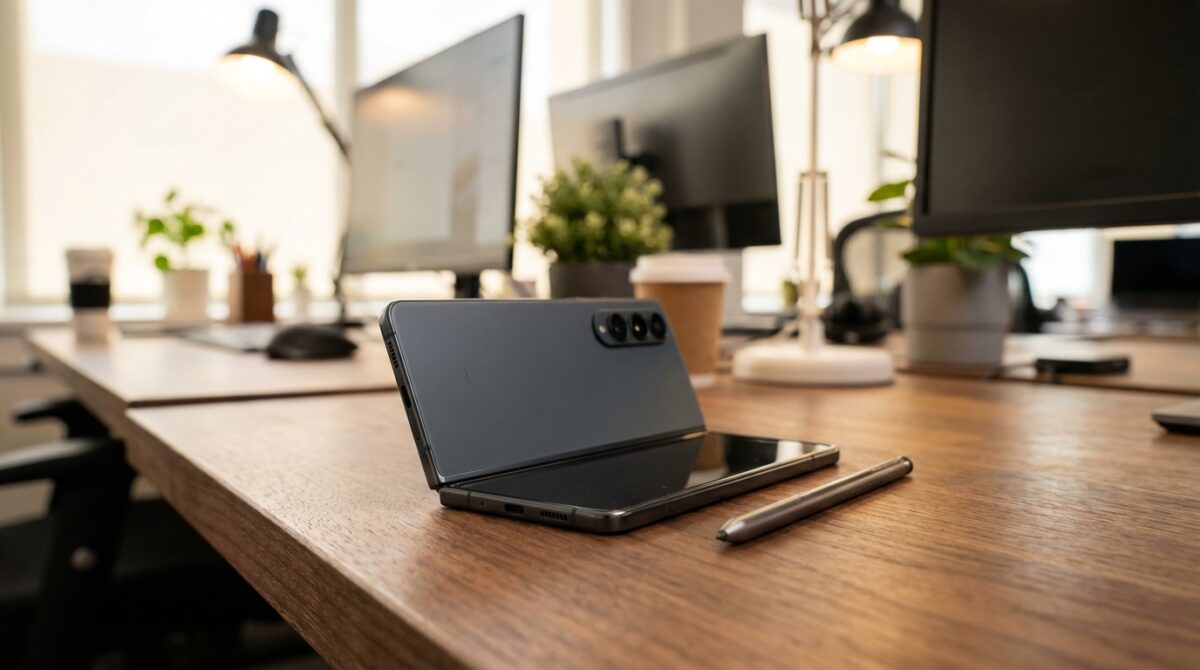
The Razr name has long been associated with flip-style foldables, yet the Motorola Razr Fold takes a different direction. This time, you are looking at a book-style foldable display that opens into a tablet-like workspace. Early hands-on reports, including coverage from outlets such as MobileSyrup, highlight how refined the hinge and overall smartphone design feel compared with first-generation rivals. The handset aims to close flat with minimal crease visibility, reducing one of the main visual distractions that have plagued foldable technology since the first Galaxy Fold experiments.
When open, the inner screen stretches to a large canvas suitable for multitasking, document editing, or immersive video. When closed, the outer display allows you to handle quick interactions without flipping the device wide. This duality has always been the promise of foldables; where the Motorola Razr Fold stands out is in how confidently it behaves as a primary mobile flagship rather than a compromise between phone and tablet. For professionals, that translates into a single device that adapts to different work modes instead of forcing them to juggle multiple screens.
Performance, software support, and long‑term value for power users
Under the hood, the Motorola Razr Fold runs on Qualcomm’s Snapdragon 8 Gen 5 chipset, aligning it with the most powerful Android phones announced for this generation. That matters because foldable smartphone multitasking pushes processors harder than standard devices. When you are running two apps side by side on a large internal panel, hopping between a video call, cloud documents, and a design tool, any hesitation becomes frustrating. The 8 Gen 5 platform is built to keep those transitions responsive, even under sustained load.
Equally significant is Motorola’s commitment to “up to” seven years of operating system upgrades and security patches. This level of support, already adopted by other major Android players, treats the Razr Fold as a long-term investment rather than a short-lived experiment. If you are planning a purchase cycle similar to a laptop, knowing that your mobile flagship will remain secure and current for most of a decade changes the cost-benefit equation. Publications such as DigiTrendz and Tom’s Guide underline how this software roadmap places pressure on competitors, especially in a segment where devices are expensive and expectations are higher.
Stylus, ecosystem, and the wider foldable smartphone landscape
One subtle but meaningful difference in the Motorola Razr Fold package is the Moto Pen Ultra stylus included in the European price. This accessory transforms the phone from a media device into a portable workstation. Designers can sketch directly on the inner display, executives can annotate PDFs during flights, and students can treat the device as a digital notebook. Coverage from outlets like PCMag has highlighted how this move brings Motorola into direct competition with stylus-first ecosystems, not only in phones but also in tablets.
At the same time, the Razr Fold arrives in a broader wave of smartphone innovation. Major events such as the technology showcases in Barcelona, covered by sites like The Black Dog Chester, show that foldables are moving from curiosity to mainstream roadmap. Even companies like Apple are rumored to explore new clamshell designs, as suggested in analysis pieces about possible future iPhones. In this context, Motorola’s book-style mobile technology entry feels less like a gamble and more like a strategic necessity. For buyers choosing their next device, the Razr Fold stands not only as a single product but as a sign of where high-end smartphone design is heading.
Key reasons the Motorola Razr Fold feels truly premium
When you step back and evaluate the device, several factors explain why the Motorola Razr Fold is perceived as a genuine flagship contender rather than a niche gadget. Each of these elements contributes to a more mature, confident interpretation of what a foldable smartphone can be for daily use, not just for enthusiasts.
- Flagship-tier price and positioning that match its ambitions in the high-end smartphone market.
- Silicon-carbon 6,000mAh battery with 80W wired and 50W wireless charging for demanding workflows.
- Triple 50‑megapixel camera system tuned for mobile photography, zoom, and macro flexibility.
- Book-style foldable display that supports productivity, media, and stylus input on a single device.
- Snapdragon 8 Gen 5 performance combined with up to seven years of software and security support.
How much will the Motorola Razr Fold cost at launch?
Motorola has announced a European launch price of €1,999 for the Razr Fold, which includes the Moto Pen Ultra stylus. The exact US price has not been confirmed, but the European figure translates to roughly $2,350 and places the device firmly in the premium foldable segment.
What makes the Razr Fold different from earlier Motorola foldables?
Previous Motorola Razr devices focused on flip-style clamshell designs with smaller inner displays. The Razr Fold adopts a book-style form factor that opens into a large tablet-like screen, supports advanced multitasking, and is positioned as a true mobile flagship competing directly with Samsung’s and Google’s folding phones.
How strong is the battery life on the Motorola Razr Fold?
The Razr Fold uses a 6,000mAh silicon-carbon battery, one of the largest capacities in a foldable smartphone. Combined with 80W wired and 50W wireless charging, it is designed to support intensive scenarios such as video calls, document editing, and media consumption without forcing users to recharge multiple times per day.
Is the camera system comparable to non-foldable flagships?
At Last! My Ultimate Camera Phone Is Here: An In-Depth Review of Xiaomi’s Leica Leitzphone
The Most Exciting Galaxy S26 Ultra Feature That Also Sparks a Bit of Paranoia
The phone features a 50‑megapixel Sony LYTIA main sensor, a 50‑megapixel 3x zoom lens with optical stabilization, and a 50‑megapixel ultrawide that also functions as a macro camera. This configuration places it in the same conversation as leading slab-style flagships, while the foldable design allows creative framing and use of the main cameras for selfies.
How long will Motorola support the Razr Fold with updates?
Motorola indicates that the Razr Fold will receive up to seven years of operating system upgrades and security updates. That commitment aligns with the current standards for top-tier Android phones and strengthens the long-term value of investing in a high-priced foldable flagship.