Show summary Hide summary
- Hyperos 3 rollout status and why 95% matters now
- The last smartphones finally receiving Hyperos 3
- Hyperos 3 on POCO and tablets: the overlooked beneficiaries
- Why Xiaomi is racing toward Hyperos 3.1 compatibility
- Checking if your Xiaomi, Redmi or POCO is included
- Practical steps before and after installing Hyperos 3
- Which devices are in the final Hyperos 3 rollout wave?
- Why must Hyperos 3 be installed before Hyperos 3.1 arrives?
- How can I check if my phone is compatible with Hyperos 3?
- Does Hyperos 3 require Android 16 on every device?
- Is it safe to install Hyperos 3 on older mid-range phones?
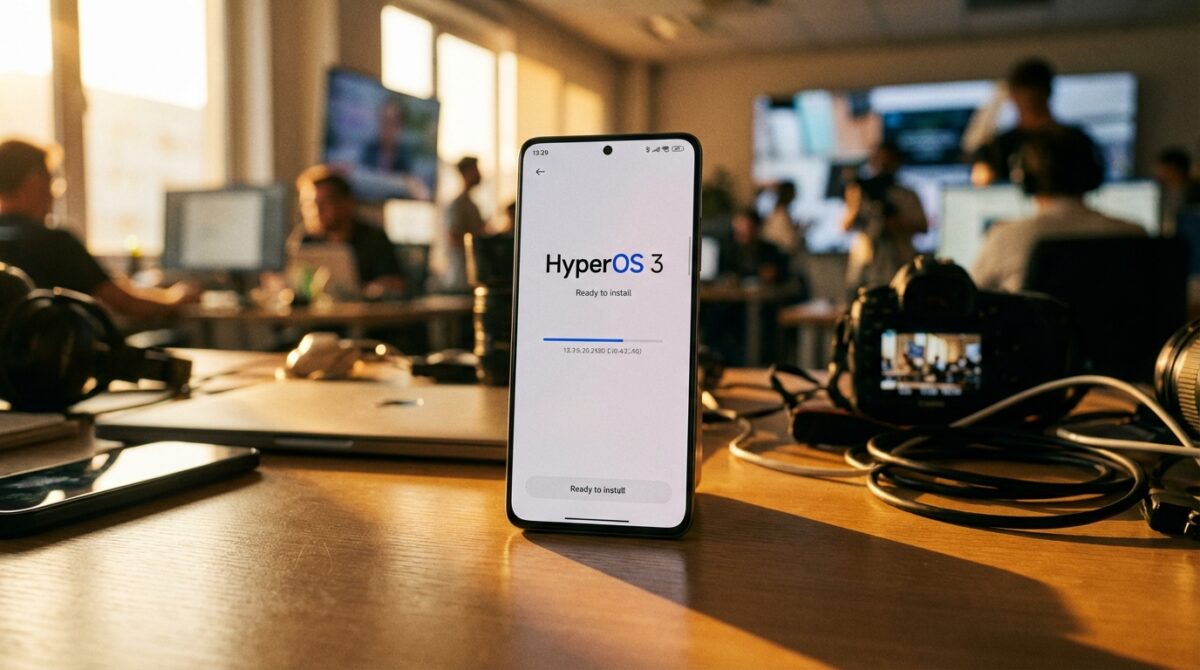
Imagine checking your Xiaomi phone tonight and discovering it suddenly feels faster, smarter, and more tightly integrated with your other devices. That is what the final wave of Hyperos 3 is delivering, as Xiaomi races to complete a rollout that already covers 95% of eligible models worldwide.
Hyperos 3 rollout status and why 95% matters now
The Hyperos 3 software update started rolling out broadly in August 2025, and Xiaomi now reports that about 95% of the target smartphones and tablets have migrated to the new mobile OS. This is not a vanity milestone. By concentrating the remaining effort on affordable entry-level models and a few delayed global variants, the company is aligning its entire ecosystem behind one common operating system baseline.
The timing is strategic. Xiaomi must finish this Hyperos 3 wave before Hyperos 3.1 begins to deploy at the end of February, otherwise version conflicts at kernel level could appear between branches of the operating system. Different low-level structures would complicate maintenance, security patches, and future upgrades. For users, that risk would translate into inconsistent performance or delayed features, so the accelerated push to reach the last 5% is a direct investment in long‑term stability.
Apple watch series 11 returns to the market at an attractive $299 price
Vivo and oppo bring their telephoto lens extender technology to the iphone
The last smartphones finally receiving Hyperos 3
Behind the impressive 95% coverage, the real story lies in the specific smartphones that are finally joining the Hyperos 3 club. According to several trackers and reports from sites such as Notebookcheck, Xiaomi has entered the closing phase with a concentrated list of models. On the flagship side, the Xiaomi 13T stands out as the last major premium device still on the waiting list for some global and EEA builds, despite already seeing preliminary versions on Chinese and Indian ROMs.
The rest of this final batch is dominated by mid-range and entry-level lines. The Redmi Note 15 series, including Redmi Note 15 5G, Redmi Note 15 4G, and the more affordable Redmi Note 15C in both 5G and 4G variants, is scheduled to receive the update as Xiaomi stabilises regional firmware. The Redmi Note 14R and Redmi Note A4 also move up in the queue, showing that even budget-conscious buyers will gain access to the latest technology rather than being left on outdated software.
Hyperos 3 on POCO and tablets: the overlooked beneficiaries
While most tech news focuses on Xiaomi flagships, Hyperos 3 has a significant impact on POCO devices and tablets as well. In this closing wave, POCO C85 (4G and 5G), POCO C75 5G, POCO M7 5G, and POCO M7 Plus are all lining up for the upgrade. These models target users who value price over raw specifications, yet they are now being brought onto the same modern operating system layer as premium phones, reducing fragmentation across the brand portfolio.
On the tablet front, two products receive particular attention: Redmi Pad Pro 5G and POCO Pad. Bringing Hyperos 3 to these larger-screen mobile devices extends Xiaomi’s Human x Car x Home vision, where tablets act as control hubs for IoT equipment, entertainment dashboards, or productivity companions. Once the update arrives, owners can expect smoother multi-device handoffs and more consistent interface behaviour between their phone and tablet, which significantly improves perceived quality across the ecosystem.
Why Xiaomi is racing toward Hyperos 3.1 compatibility
The pressure to finish the Hyperos 3 deployment before the end of February is not only about marketing or nice round numbers. From an engineering perspective, distributing Hyperos 3 and Hyperos 3.1 simultaneously to the same hardware family would create a murky environment for kernel structures and system libraries. Development teams would need to support parallel branches of the mobile OS, complicating debugging and slowing security work across mobile devices.
By ensuring that every eligible phone and tablet reaches a stable Hyperos 3 state now, Xiaomi creates a consistent foundation for the transition to 3.1, which is expected to introduce deeper changes and Android 16-based improvements on selected models. Analysts following HyperOS evolution on sites such as HyperOS Update indicate that the next iteration will rely heavily on this unified baseline. For you, that means fewer unexpected bugs during future upgrades and a clearer path for long-term device compatibility.
Checking if your Xiaomi, Redmi or POCO is included
With so many models spread across multiple brands and regions, staying informed about Hyperos 3 availability can feel confusing. Xiaomi publishes phased rollout plans, yet these are often updated as internal testing progresses. Enthusiast communities and independent trackers help bridge this gap by compiling confirmed software update timelines and device lists in near real time, which is particularly helpful if you manage several smartphones in your family or company.
If you want to verify eligibility, you can start with consolidated lists such as those gathered by Unbox Diaries in their overview of smartphones that may receive HyperOS 3. Cross-check that information with your region, because some models gain the update earlier on Chinese or Indian ROMs while global and EEA editions follow weeks later. Then open Settings on your device, look for System update, and trigger a manual check to see whether Hyperos 3 is already staged for download on your specific build.
Practical steps before and after installing Hyperos 3
Once your device is confirmed eligible, the way you prepare for the installation can shape your experience. Before you start the download, make sure your battery is at least half charged or keep the phone plugged in. A stable Wi‑Fi connection reduces the risk of corrupted files, especially on larger firmware packages that integrate Android 16 components. Backing up your photos, documents, and messaging history to the cloud or an external drive adds an extra layer of safety in case you decide to perform a factory reset afterwards.
After installation, take a moment to explore key sections of the operating system. Check privacy permissions, notification rules, and battery management options, since defaults might have changed compared to MIUI or earlier HyperOS versions. If you notice unexpected behaviour on a specific app, try clearing its cache or reinstalling it, as some third-party tools need to rebuild their compatibility with the refreshed framework. Treat this upgrade as an opportunity to clean unused apps and optimise your daily workflow on the new platform.
- Verify that your model appears on an official or community Hyperos 3 eligibility list.
- Confirm that you are using the correct regional ROM (Global, EEA, India, or China).
- Back up all critical data before you start the software update.
- Install Hyperos 3 over Wi‑Fi with sufficient battery or while charging.
- Review privacy, notifications, and battery settings after the installation completes.
Which devices are in the final Hyperos 3 rollout wave?
The last wave focuses on a limited set of smartphones and tablets. On the Xiaomi side, the Xiaomi 13T is the last major flagship still waiting for some global and EEA builds. In the Redmi family, models such as Redmi Note 15 Pro 4G, Redmi Note 15 (4G and 5G), Redmi Note 15C (4G and 5G), Redmi Note 14R, and Redmi Note A4 are included. For POCO, C85, C75 5G, M7 5G, and M7 Plus are scheduled, alongside tablets like Redmi Pad Pro 5G and POCO Pad.
Why must Hyperos 3 be installed before Hyperos 3.1 arrives?
Xiaomi wants all eligible mobile devices on the same stable base before releasing Hyperos 3.1. Running two major branches with different kernel structures at the same time would complicate maintenance and might generate version conflicts during future security or feature updates. Completing the Hyperos 3 rollout first ensures a unified foundation, making upcoming 3.1 deployments smoother and more reliable for users.
How can I check if my phone is compatible with Hyperos 3?
You can combine several methods. First, consult updated compatibility lists on specialised sites that track Xiaomi software update plans. Then, verify the exact model number and region of your smartphone or tablet, because some versions share names but not firmware. Finally, open Settings, go to System update, and run a manual check. If your device is part of the current wave, Hyperos 3 should appear as a downloadable package.
Does Hyperos 3 require Android 16 on every device?
This budget-friendly e-reader brims with both challenges and promise
Apple’s iPhone 20 in 2027: A Revolutionary All-Glass Design with No Buttons
No, Hyperos 3 does not rely on Android 16 for all smartphones. Some high-end and recent mid-range models are expected to use Android 16 as their base layer, while others keep an earlier Android version under the HyperOS interface. Xiaomi adapts the underlying Android level according to hardware capabilities and long-term support plans, yet aims to deliver a consistent user interface and feature set across the portfolio whenever possible.
Is it safe to install Hyperos 3 on older mid-range phones?
For models officially listed as compatible, the update is tested to run within acceptable performance and stability limits. Older mid-range devices may not gain every new feature or Android 16 capability, yet they still benefit from security patches, interface refinements, and better integration with newer Xiaomi products. To minimise issues, perform the upgrade with a clean storage environment and consider resetting the device if you encounter persistent slowdowns afterwards.