
Show summary Hide summary
- Why Starbase wants its own local court system
- How the Starbase judicial system will fit into Texas law
- Building a police department around a space launch site
- Legal framework and space law pressures at Starbase
- What Starbase’s court means for residents and visitors
- Key implications for civic life in a company-linked city
- What types of cases will the Starbase local court handle?
- How does the new judicial system affect SpaceX operations?
- Why is Starbase creating its own police department?
- Is Starbase unique among Texas cities in having a company-linked court?
- Could Starbase’s legal framework influence future space settlements?
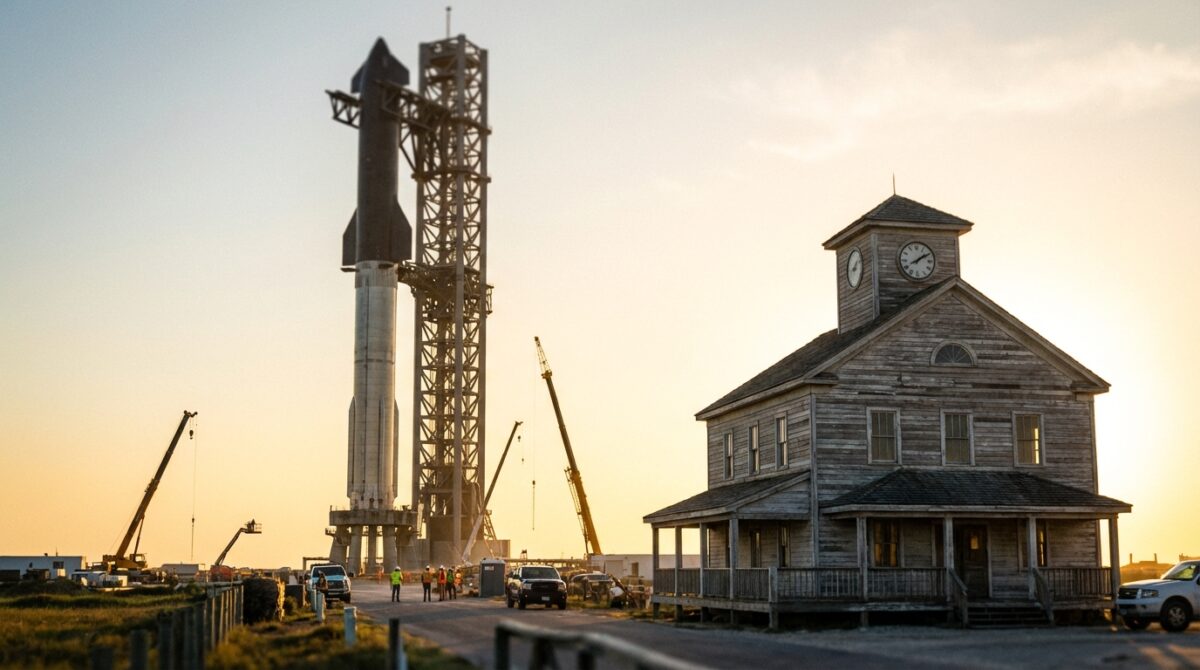
Just a few years ago, a private rocket launch site in South Texas looked like an industrial outpost; now that same place is preparing its own local court and police force. Starbase, the city built around SpaceX’s Starship complex, is quietly becoming a living laboratory for how justice works in a company town.
Why Starbase wants its own local court system
When a city of a few hundred residents decides to build a judicial system almost from scratch, something important is happening. Starbase, incorporated as a small Texas municipality near the Rio Grande, already runs a volunteer fire department, issues building permits, and performs fire code inspections. The next move is the creation of a local court tailored to a community shaped by the space industry.
During a recent city commission meeting, the city administrator presented an ordinance to establish a municipal court with a part-time judge, prosecutor, and court clerk. Until a permanent judge is appointed to a two-year term, the mayor will serve on the bench. According to the administrator, a candidate could be ready for commission approval as early as the next monthly meeting, underscoring how quickly Starbase wants court jurisdiction operating inside city limits.
Apple TV’s The Hunt Sets Official Premiere Date at Last
New York Abandons Robotaxi Legalization, Delivering a Blow to Waymo’s Expansion Plans
Public safety pressures behind the judicial push
The decision is not driven only by ambition or branding. Starbase recorded 420 calls for law enforcement, 180 fire calls, and 140 EMS incidents over the last year. On top of that, there were 353 documented crashes in the area, with more than 7,000 vehicles traveling Highway 4, the narrow road connecting the town to the rest of Texas, every day. A basic traffic incident near a rocket facility raises different stakes than a similar crash in a typical suburb.
City leaders argue that relying solely on Cameron County’s deputies no longer matches these realities. County officials, according to documents submitted with the court proposal, cannot guarantee dedicated coverage for Starbase at all times. The city describes its location as remote and its needs as requiring rapid and reliable response. A local judicial system is therefore seen as part of a wider effort to control how law, safety, and operations interact around SpaceX assets.
How the Starbase judicial system will fit into Texas law
Starbase is organized as a general-law Type C municipality under Texas statutes, which grants limited but significant self-governing powers. The planned local court would handle low-level criminal cases, traffic violations, and municipal ordinance enforcement. That includes building codes, zoning rules, and event permits tied to launch operations. The model resembles other small Texas towns, yet the context of heavy-industry spaceflight makes its application different.
Under the proposed ordinance, the municipal judge will be part time, appointed rather than elected, at least in the first cycle. A prosecutor and court clerk will support the docket, which is expected to grow as Starbase’s population and visitor numbers increase. Articles such as this analysis of how Starbase establishes a municipal court to serve a growing population suggest that the court will be central to enforcing safety boundaries around launch days and construction phases.
Court jurisdiction in a company town shaped by rockets
Jurisdiction for the Starbase local court will sit primarily within city boundaries, yet its influence may extend symbolically further. The court will likely become the venue for disputes involving construction code compliance around the SpaceX launch complex, permitting for mass viewing events, and enforcement of noise or access rules on busy test days. City leaders already highlight a “substantial governmental interest” in preserving the integrity of spaceflight activities under their control.
At the same time, serious offenses will continue to flow through Cameron County’s broader judicial system. Starbase intends to keep paying for access to the county jail network, using local police and court functions as a front line rather than a complete replacement. This hybrid structure mirrors arrangements in other specialized industrial towns, but the scale and visibility of rockets place Starbase under a much brighter spotlight than a typical refinery community.
Building a police department around a space launch site
The municipal court does not stand alone; it is part of a coordinated public safety buildout. After a plan to secure long-term patrol contracts with the county sheriff’s office collapsed, Starbase chose to pursue its own police department. An application to the Texas Commission on Law Enforcement outlines a six-month roadmap to create the Starbase Police Department, including training, equipment, and coordination with county authorities for detention services.
In that application, officials emphasize that a growing population, rising property values, and high household incomes are raising expectations for local services. Many residents either work for SpaceX or in supporting roles, and they expect rapid, professional responses when incidents occur near multimillion-dollar test hardware. Commentators tracking these developments, such as those at outlets covering Starbase’s police plans as SpaceX assets expand, argue that dedicated policing is becoming a prerequisite for operating a large private spaceport next to homes and tourist areas.
From fire calls to launch-day crowd control
Starbase already runs a volunteer fire department that responds to industrial risks as well as residential emergencies. As launch cadence increases, first responders must anticipate crowd control, potential debris, and coastal hazards. A coordinated structure linking police, fire, EMS, and the new court system is seen as vital for maintaining public confidence around high-risk activities.
Imagine a launch that draws thousands of spectators to a narrow strip of coast. Traffic has to be directed, unauthorized drones kept clear of flight paths, and improvised parking managed on fragile coastal land. Every one of those issues can generate citations, disputes, or minor offenses. Without a responsive local court and law enforcement presence, incidents would pile up in a distant county docket, delaying resolutions that matter for both residents and rocket operators.
Legal framework and space law pressures at Starbase
Behind the municipal details sits a deeper tension between traditional local governance and the specialized regulatory environment of the space industry. SpaceX operations already answer to the Federal Aviation Administration for launch licensing, as well as to federal agencies overseeing environmental and coastal rules. The new municipal court adds another layer by shaping how local ordinances interact with those national regimes on the ground.
Questions of space law typically focus on orbital debris treaties or planetary protection, yet the Starbase experiment shows how terrestrial law must adapt first. Who bears responsibility when a traffic jam caused by launch spectators prevents an ambulance from reaching a resident? How should city code treat homes built within earshot of engines designed to leave Earth’s atmosphere? The local judicial system will become the venue in which these practical, Earth-bound aspects of space law are argued.
Starbase as a test case for future space cities
Urban planners and legal scholars have started studying Starbase alongside historical company towns like Pullman or mining settlements. Analyses such as those examining how SpaceX gets a crash course in launching a company town argue that the city could preview governance models for future off-world communities. If a Mars settlement ever exists, it will need some analogue of a municipal court long before complex planetary treaties are tested.
For now, the stakes remain decidedly Texan. Starbase must balance the interests of residents, the economic weight of SpaceX, and the oversight of state and federal regulators. Decisions made by a part-time judge in a modest coastal city hall may set patterns for how company-linked jurisdictions manage safety and rights when heavy industry and everyday life collide.
What Starbase’s court means for residents and visitors
For people living and working in Starbase, the new court promises faster resolutions and rules that feel locally informed. Residents who file complaints about noise, construction, or access during busy launch periods will deal with city officers and a judge familiar with the specific rhythms of rocket testing. That intimacy can build trust, provided the court maintains visible independence from corporate interests.
Visitors, especially those arriving for major launches, will encounter a town that can enforce parking, crowd, and safety regulations on the spot. Fines, hearings, and appeals will be processed locally, reducing confusion about which agency is in charge. For SpaceX, a predictable municipal partner capable of handling routine disputes and compliance issues allows engineers and managers to focus attention on flight readiness instead of ad hoc negotiations with multiple external authorities.
Key implications for civic life in a company-linked city
The creation of a municipal court also raises questions for civic culture. Residents must consider how they participate in city commission meetings, how they monitor court decisions, and how they hold appointed officials accountable. A city administrator, an appointed judge, and SpaceX-linked commissioners together shape a governance triangle that residents like a fictional engineer, Maria, navigating both home ownership and rocket test schedules, will have to understand.
Maria might attend a hearing about new zoning rules that affect her street’s access during static fire tests. She might contest a parking citation issued on a launch day when roadblocks shifted without clear signage. Her experience of local democracy will flow not only through elections, but through courtroom proceedings and ordinance debates. In that sense, the Starbase local court becomes a civic classroom for a community learning to live beside heavy-lift rockets.
- Municipal court: Handles local ordinances, traffic, and minor criminal matters.
- Police department: Provides dedicated patrols and rapid response within Starbase.
- Volunteer fire service: Manages industrial and residential fire risks around the launch complex.
- County partnership: Supplies jail facilities and higher-level judicial processing.
- Federal regulators: Oversee launch licensing and spaceflight safety above the local level.
What types of cases will the Starbase local court handle?
The Starbase municipal court is expected to address low-level criminal offenses, traffic violations, and enforcement of city ordinances, including building codes, zoning rules, and event permits linked to launch activity. More serious crimes will still move through Cameron County courts, which retain responsibility for felonies and use of county jail facilities.
How does the new judicial system affect SpaceX operations?
A functioning local court gives SpaceX a clearer legal framework for day-to-day issues around the launch site, such as crowd control, road closures, and safety boundaries. By resolving minor disputes locally and quickly, the company gains more predictable conditions for scheduling tests and launches, while regulators and residents see that public safety concerns have a forum close to the site.
Why is Starbase creating its own police department?
City officials report rising call volumes, frequent traffic incidents on Highway 4, and limited availability of dedicated county patrols. They argue that a local force can respond faster to emergencies and manage the specific risks around a private spaceport. The police department will work closely with the municipal court, while still relying on Cameron County for detention and higher-level criminal processes.
Is Starbase unique among Texas cities in having a company-linked court?
Dyson Unveils the Innovative PencilWash: Revolutionizing Wet Floor Cleaning
TechCrunch Mobility: How Rivian Found Its Lifeline
Several Texas company towns have historically operated municipal courts, but Starbase is unusual because its economy revolves around orbital launch operations rather than extractive industries. That makes its ordinances and court rulings closely intertwined with space industry regulations, providing a new type of test case for how municipal justice operates in a high-technology setting.
Could Starbase’s legal framework influence future space settlements?
Researchers studying governance models suggest that Starbase may offer early lessons for regulating communities heavily dependent on spaceflight. The way it balances municipal authority, corporate influence, and higher-level regulation could inform policies for future spaceports, orbital stations, or even off-world habitats, where some version of a local court and police system will still be necessary to manage daily conflicts.