Show summary Hide summary
- Why this joint Open Letter from tech workers matters
- Inside the solidarity with Anthropic over Pentagon demands
- How Google and OpenAI staff built cross‑company AI collaboration
- Leadership responses from Sam Altman and the wider AI ecosystem
- What this moment means for tech workers and AI governance
- Practical lessons for leaders watching Google, OpenAI and Anthropic
- Key takeaways for organizations building sensitive AI tools
- Who signed the Open Letter supporting Anthropic?
- What were the main red lines mentioned in the letter?
- How did company leadership respond to the employees’ stance?
- Why is the Pentagon described as trying to divide AI companies?
- What does this episode mean for future AI governance?
Inside two of the world’s most powerful AI labs, hundreds of engineers just told their bosses “no.” Their Open Letter does not debate abstract ethics; it rejects specific Pentagon demands, from domestic mass surveillance to autonomous killing, and asks Google and OpenAI to stand with Anthropic instead of competing for military favor.
Why this joint Open Letter from tech workers matters
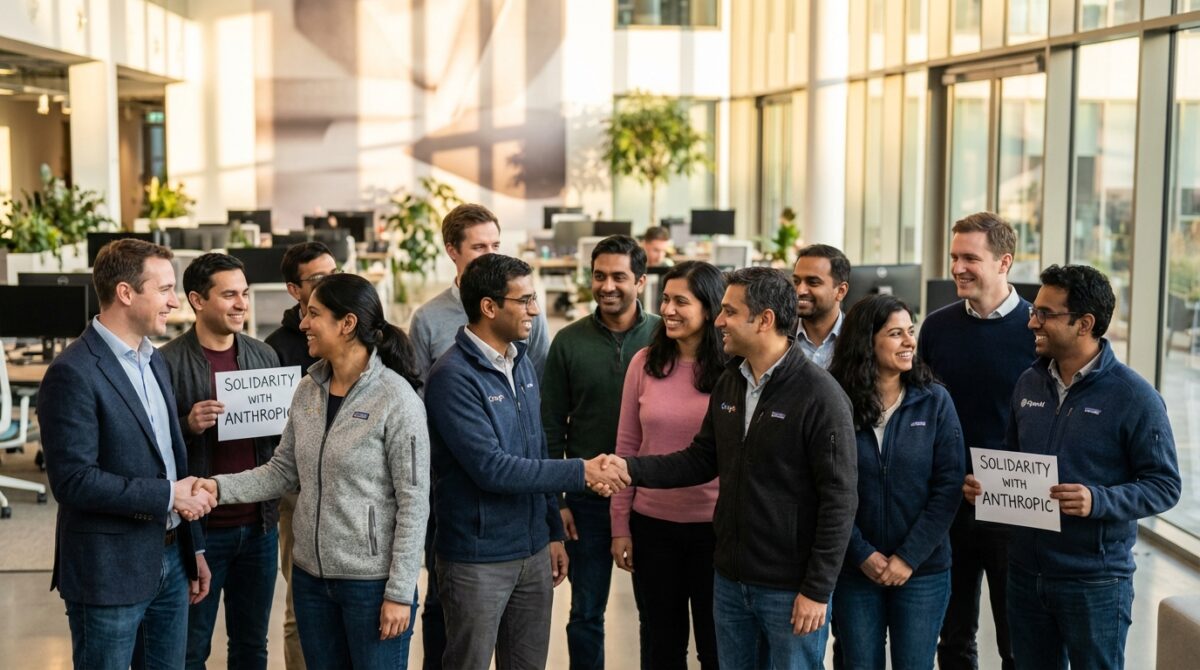
The Open Letter titled “We Will Not Be Divided” landed like a shockwave across Artificial Intelligence circles. You have Google and OpenAI employees, often portrayed as rivals, suddenly acting as one bloc of Tech Workers drawing a firm line. Their message is direct: they will not help normalize AI systems used for domestic mass monitoring or weapons that kill without human oversight.
For leaders in any digital business, this is more than an internal protest. It signals that the people who design and maintain AI infrastructure are willing to organize publicly when red lines are crossed. Hiring top engineers is no longer enough; you must now align product roadmaps with their ethical expectations. When staff at Google, OpenAI and Anthropic converge on the same boundaries, it becomes harder for any one firm to quietly sign a risky government contract.
Honor Announces Launch of Its Innovative Robot Phone Scheduled for Later This Year
Commemorate 30 Years of Pokémon with a Retro Game Boy-Inspired Music Player

Inside the solidarity with Anthropic over Pentagon demands
The immediate trigger for this wave of Solidarity was the confrontation between Anthropic and US Defense Secretary Pete Hegseth. According to people familiar with the talks, the Pentagon hinted that Anthropic could be labeled a “supply chain risk” unless it relaxed safety guardrails for classified projects. The disputed restrictions reportedly concern surveillance capabilities and the use of Claude-like models in lethal military systems without strict human control.
Anthropic’s CEO Dario Amodei had already articulated two non‑negotiable lines: no support for domestic mass surveillance and no contribution to autonomous killing. When threats over supply‑chain status entered the picture, many AI specialists saw an attempt to exploit competitive pressure. The Open Letter argues that the government is “trying to divide each company with fear that the other will give in,” turning collaboration into a race to the bottom on safety.
How Google and OpenAI staff built cross‑company AI collaboration
One striking detail is that the original organizers of the Open Letter do not work for any AI company, political party, or advocacy group. They describe themselves as independent actors who simply verified signatories as active employees. That verification step matters; it reassures readers that the 450 signers really are insiders at Google and OpenAI, not anonymous accounts amplifying a narrative from the sidelines.
Roughly 400 signatories come from Google, with the rest from OpenAI. About half attached their real names, while the others chose anonymity for safety or career reasons. This mix illustrates a new pattern of AI Collaboration: public enough to generate pressure on leadership, but flexible enough to protect vulnerable workers. For a manager like our fictional product lead Maya, it signals that informal networks now span companies and cannot be managed through internal channels alone.
Leadership responses from Sam Altman and the wider AI ecosystem
The staff initiative did not appear in a vacuum. OpenAI CEO Sam Altman told employees in an internal memo that his company would respect the same red lines described by Anthropic. In an interview with CNBC, he added that he does not think the Pentagon should be using tools such as the Defense Production Act as leverage against AI labs over these issues. That stance offers some reassurance to OpenAI staff who fear being sidelined or punished for speaking up.
At the same time, the Pentagon has reportedly discussed classified projects not only with Google and OpenAI, but also with xAI, which recently entered the conversation. That expansion of potential partners heightens the risk of fragmentation. If one player accepts looser safety constraints, pressure intensifies on others to follow. The Open Letter aims to stop that spiral early, by encouraging executives to coordinate basic boundaries rather than quietly competing on compliance.
What this moment means for tech workers and AI governance
For many readers, the most practical question is how this shift affects day‑to‑day work. The answer is already visible inside large engineering teams. Young researchers evaluate employers not only on salary and publications, but on how leadership handles dilemmas such as military AI. Episodes like the long Iranian internet shutdown, documented in sources such as this detailed analysis, shape how staff perceive state power and surveillance requests.
Companies that rely heavily on AI talent need an internal playbook before similar conflicts reach their door. Clear positions on surveillance, automated weapons, and cooperation with security agencies tend to reduce uncertainty for teams. They also help align communications with external stakeholders, from regulators to civil society groups. The Open Letter shows that employees will likely test those positions, and may coordinate across organizations when they feel unheard.
Practical lessons for leaders watching Google, OpenAI and Anthropic
For executives, the episode offers a concrete checklist. You can treat it as a preview of conflicts that may appear once your own AI systems gain strategic value. The same dynamic seen around Anthropic, Google and OpenAI will likely recur in health, finance, or energy, where AI can deeply affect rights and safety. Preparing now reduces the likelihood of rushed decisions under pressure from either government or investors.
Several actions stand out for leaders who want to avoid a similar collision. Transparent guardrail policies, genuine consultation with internal experts, and a shared stance with peer companies on minimal standards all help. Readers who follow digital rights debates can also look at how long network shutdowns, described in investigations like this overview of Iran’s extended blackout, influence public trust when technology firms are seen as too close to security authorities.
Key takeaways for organizations building sensitive AI tools
When you translate this episode into operational guidance, several patterns emerge that are useful beyond the AI giants. The combination of public pressure, internal organization and geopolitical tension creates a demanding environment for any company deploying advanced models. Treat the following points as starting prompts for board‑level discussion rather than a final recipe.
- Define non‑negotiable red lines for AI use, especially around surveillance and lethal applications.
- Create confidential channels where staff can question sensitive contracts without fear of retaliation.
- Coordinate with peers on baseline safety rules to avoid “race to the bottom” government bidding.
- Document how you evaluate state requests, including criteria for saying “no.”
- Explain these policies to employees, investors, and the public in consistent, accessible language.
Who signed the Open Letter supporting Anthropic?
More than 450 verified employees from Google and OpenAI signed the Open Letter, with roughly 400 from Google and the rest from OpenAI. Around half of the participants chose to reveal their names publicly, while the others remained anonymous for personal or professional protection. All were confirmed as current staff members, according to the independent organizers.
What were the main red lines mentioned in the letter?
The signatories endorsed two clear boundaries that mirror Anthropic’s position: rejecting the use of their AI models for domestic mass surveillance, and refusing involvement in systems designed to kill people autonomously without meaningful human oversight. They argue that crossing these lines would undermine public trust and create dangerous precedents for future AI deployments.
How did company leadership respond to the employees’ stance?
OpenAI CEO Sam Altman told employees that the company would respect the same limits on military work that Anthropic expressed, and publicly criticized the idea of the Pentagon using legal pressure to change those positions. At Google, leaders have not disclosed every detail of ongoing discussions, but the scale of internal support for the letter raises the cost of ignoring staff concerns.
Why is the Pentagon described as trying to divide AI companies?
Set Sail with Pokémon Winds and Waves on Nintendo Switch 2 Releasing in 2027
Google Maps Set to Offer Full Features in South Korea
According to the letter, officials are attempting to negotiate separately with Google, OpenAI, Anthropic, and others, hinting at advantages or risks depending on each firm’s level of cooperation. By doing so, they create fear that if one company refuses certain demands, a competitor will accept them instead. The signatories want firms to align on shared boundaries to reduce this pressure.
What does this episode mean for future AI governance?
The incident suggests that governance of Artificial Intelligence will not be shaped by regulators and executives alone. Organized Tech Workers inside major labs now influence which contracts move forward, particularly where security and human rights are concerned. Their willingness to coordinate across rival companies indicates that future AI policies will emerge from negotiation among governments, firms, employees, and civil society at the same time.