
Show summary Hide summary
Picture this: a single text prompt spins up a vast fantasy continent, living NPCs, meaningful quests, and emergent politics. You play for months, yet no human level designer ever touched the map. That promise drives billions in AI investment, yet the reality still feels oddly empty.
AI limitations in building truly immersive game worlds
When studios talk about artificial intelligence creating immersive worlds, they often point to procedural generation as proof that the future is nearly here. Older titles like Rogue and later Minecraft already generated endless landscapes, dungeons, and caves. Those systems, however, rely on carefully crafted rules, not open-ended neural models, and they still demand intense human curation to feel coherent for your player experience.
Generative models change the pitch. Instead of rules, they ingest oceans of gameplay videos and screenshots, then predict what the next frame or interaction might look like. Google’s Genie 3, described in detail in a report on interactive world-building prototypes, illustrates both the potential and the gap. In theory, it understands how a platformer behaves. In practice, its worlds feel like fuzzy memories of better games: silent backgrounds, floaty physics, and actions with little consequence.
OpenAI Officially Retires the Controversial GPT-4o Model
Google Uncovers Hackers Using Thousands of AI Prompts to Imitate Gemini
That gap reveals three hard AI limitations. First, spatial and systemic consistency over hours of play is difficult for models trained on short video clips. Second, interactive depth is far more complex than predicting the next frame; players test edge cases, push physics, and subvert rules. Third, emotional resonance in world-building depends on theme, pacing, and metaphor, which are still shaped best by writers and narrative designers rather than by raw pattern matching.
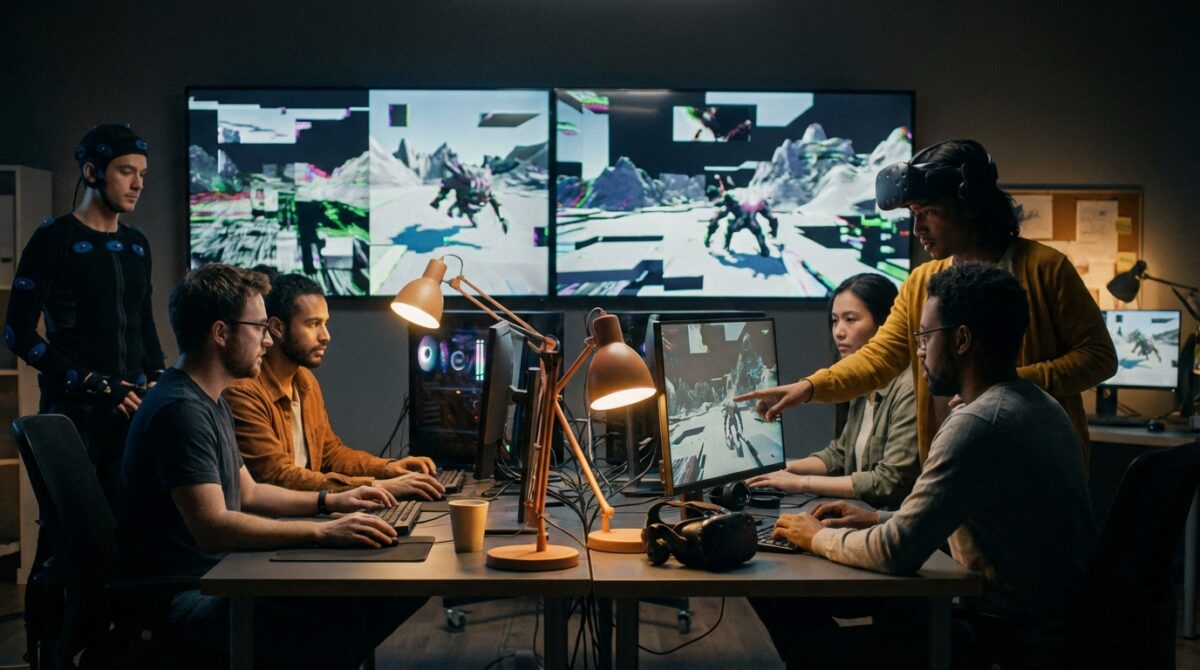
Developers describe an odd sensation when testing these tools. The game environment appears visually plausible for a few seconds, then collapses into repetition or nonsense. Enemies walk into walls, lighting shifts without narrative reason, and important objects lack clear affordances. That mismatch between first impression and long-term coherence is why many veteran designers see generative AI as a helper for assets, not an architect for the whole world.
From procedural generation to generative models in video game design
To understand why modern artificial intelligence struggles, it helps to look at how older procedural generation succeeded. Classic roguelikes used deterministic algorithms to draw dungeon rooms, place items, and spawn enemies. Designers such as Lina, a fictional lead at the studio “Silver Oak,” would tweak parameters for hours: corridor length, treasure density, trap patterns. Every change served a clear goal for tension, pacing, or resource scarcity.
This procedural tradition lives on in contemporary successes. Games like No Man’s Sky or Diablo-like loot systems rely on math-driven randomness wrapped in human-authored constraints. The system knows which weapons are allowed in early zones, how rare certain biomes should be, and how difficulty scales. Underneath, everything remains legible to designers, who can debug, rebalance, and, if needed, manually override outcomes to preserve the desired player experience arc.
Neural world models such as Genie 3 or experimental “neural engines” invert that workflow. Instead of exposing rules, they hide logic inside billions of parameters. Silver Oak’s team might type, “retro cyberpunk city with parkour platforms and light combat,” then wait for a short, playable snippet. The result can look eerily like footage seen online, yet there is no designer-friendly interface for adjusting jump arcs, signposting routes, or tuning enemy timing.
This opacity clashes with the realities of production. When a QA tester reports that a quest becomes unwinnable after a certain decision, procedural systems offer clear knobs to adjust. With many neural models, the only remedy is to regenerate content and hope the bug disappears. Reports such as analyses of struggling gaming algorithms stress that this lack of predictable control makes full generative design risky for any project with deadlines and budgets.
Creative challenges of AI-driven world-building
Creative direction in a memorable game environment goes far beyond placing walls and enemies. Lina’s fantasy RPG at Silver Oak, for example, uses environmental storytelling everywhere. Villages show scorch marks where dragons attacked years earlier. Abandoned camps whisper past failures through item placement. Each region’s color palette reflects political tension or cultural history, guiding players’ emotions without a single line of dialogue.
Generative AI, trained on countless existing games and films, tends to remix what already exists. You may receive a forest, a castle, and some ruins, yet the symbolic thread between them remains weak. Why are these ruins important to the local faction? How does the architecture express the values of a long-fallen empire? Without a strong authored vision, world-building drifts toward generic fantasy or sci-fi tropes that feel instantly forgettable for regular players.
Writers also worry about voice. Systems that autocomplete dialogue or quest descriptions can quickly drown a project in bland, interchangeable text. A villain’s monologue, once sharp and unsettling, becomes padded with clichés because the model optimizes for average language rather than for distinctive style. Articles investigating why video game AI still falls short repeatedly point to this flattening effect on narrative identity.
Another creative challenge lies in rhythm. Great games know when to let you breathe, when to surprise you, and when to confront you with moral complexity. That rhythm emerges from deliberate collaboration between level designers, composers, and writers. Generative tools, by contrast, often produce content on demand, reacting moment to moment. The risk is a “Spotify shuffle” of encounters, where each scene is plausible yet the overall arc lacks rising stakes or satisfying payoff.
Technological constraints behind AI immersive worlds
Even if every creative concern vanished, technological constraints would still limit how far AI-driven worlds can go. Real-time generation of high-fidelity environments taxes GPUs and CPUs already busy with physics, rendering, and networking. Mobile hardware, cloud latency, and bandwidth caps further restrict how much content can be streamed or recomputed during play.
Google’s Project Genie illustrates this ceiling. Sessions currently last around a minute, with simple interactions and no persistent state. You walk, jump, maybe pick up a few objects, then the world disappears once the timer ends. Turning that kind of demo into a sprawling, persistent RPG would require reliable saving of AI-generated geometry, collision data, scripts, and narrative state, all synchronized across devices and possibly multiplayer sessions.
There is also the question of safety and IP. Genie-like systems draw on vast datasets of online videos and existing games. Developers already notice uncanny echoes of famous platformers or iconic characters. Legal teams must then audit outputs to avoid copyright infringement. Meanwhile, platform holders such as Steam now ask creators to disclose generative AI usage, though not every AI-powered tool requires explicit labelling, which adds regulatory ambiguity across stores.
On top of that, debugging becomes a serious operational issue. A handcrafted quest has a finite set of states designers can test. A generative system that can produce thousands of slight variations multiplies the risk of soft locks or exploits. AI limitations here are less about intelligence and more about maintainability. Studios want reliable pipelines, not mysteries buried deep in model weights that only a few specialists can interpret.
Impact on developers, jobs, and the future player experience
For people working inside the industry, the debate is not purely theoretical. After years of layoffs across major publishers, every promise that AI will “streamline production” sounds like a coded reference to smaller teams. Reports from outlets such as analyses of AI’s impact on modern development highlight both efficiency gains and the risk of eroding specialist roles in art, QA, and writing.
Silver Oak’s internal discussions reflect that tension. Some designers welcome tools that auto-generate foliage or preliminary voice lines, freeing them to focus on core systems. Others fear a slippery slope where management pressures them to replace junior staff with prompt engineers. Union organizers already reference generative pipelines as a bargaining topic, demanding clear guarantees about authorship, royalties, and long-term career paths for creative workers.
Players will also feel the consequences. Certain experiments, such as text-driven story sandboxes or AI-directed NPC conversations, can add fresh unpredictability. At the same time, if publishers flood stores with cheaply produced, AI-heavy titles, audience trust may erode. Early backlash against obviously synthetic dialogue, uncanny character animations, or repetitive quest design shows that enthusiasts quickly recognize when content lacks human touch.
The likeliest near-term scenario is hybrid. AI assists with repetitive tasks, performs large-scale playtesting, or simulates diverse player behaviors for balancing. Human teams still define the heart of the experience: core loops, lore, and emotional beats. Industry voices comparing AI to a “powerful accelerator” rather than a replacement suggest that, despite bold predictions, immersive worlds will continue to rely on human judgment for the foreseeable future.
Why does AI struggle to create deep, immersive game worlds?
AI systems learn mainly from short clips and surface patterns, which makes them good at copying visual styles but weaker at sustaining long-term coherence, emotional arcs, and systemic depth. Immersive game worlds require consistent rules, meaningful choices, and thematic intent, all areas where human designers still excel over pattern-driven models.
How is procedural generation different from generative AI in games?
Procedural generation uses explicit rules and parameters that designers control and can easily adjust, such as spawn rates or level shapes. Generative AI relies on neural networks that infer patterns from data, often hiding the underlying logic. This makes procedural systems more predictable and tunable, while generative models are flexible but harder to debug or shape to a clear design vision.
Can AI fully replace level designers and writers?
Current evidence suggests that AI works best as an assistant, not a replacement. It can draft variations, propose layouts, or suggest dialogue snippets, yet it struggles with holistic world-building, subtext, and originality. Level designers and writers still provide the overarching structure, tone, and meaning that hold a complex game together for tens of hours.
What are the main risks of relying heavily on AI in game development?
Good Luck, Have Fun, Don’t Die: A Stylish Rebellion Against AI
Meta Aims to Integrate Facial Recognition Technology into Its Smart Glasses
Heavy reliance on AI can lead to generic worlds, unclear ownership of creative work, and technical complexity that is hard to test or maintain. There are also concerns about job displacement and legal issues around training data. Studios need governance, clear guidelines, and strong human oversight to avoid sacrificing quality and trust for short-term cost savings.
Will future advances in AI remove these limitations?
Future models will likely handle physics, interaction, and style more convincingly, reducing some visible flaws. However, the challenges of coherent storytelling, cultural nuance, and long-term world consistency are deeply tied to human judgment and taste. Even with stronger AI, many studios expect a collaborative model where tools speed production while people remain responsible for vision and final decisions.