

Show summary Hide summary
- Good Luck, Have Fun, Don’t Die as a stylish rebellion against AI
- Characters as a human firewall against automation
- From diner hostage drama to techno-apocalypse road movie
- Visual excess and pop culture echoes as technology critique
- Why this anti-AI satire resonates beyond the cinema
- Key lessons from Good Luck, Have Fun, Don’t Die
- Is Good Luck, Have Fun, Don’t Die mainly a comedy or a sci-fi thriller?
- How does the movie’s view of AI differ from classic films like Terminator 2?
- Do I need to be a tech expert to understand the technology critique?
- Why do reviewers describe the film as an anti-AI story?
- Is the movie suitable as a starting point for discussions on AI ethics?
Someone from the future storms into a Los Angeles diner and shouts: “Good Luck, Have Fun, Don’t Die.” That is not just a warning in Gore Verbinski’s film; it feels like a manifesto for anyone uneasy about AI swallowing culture, work, and even basic human attention.
Good Luck, Have Fun, Don’t Die as a stylish rebellion against AI
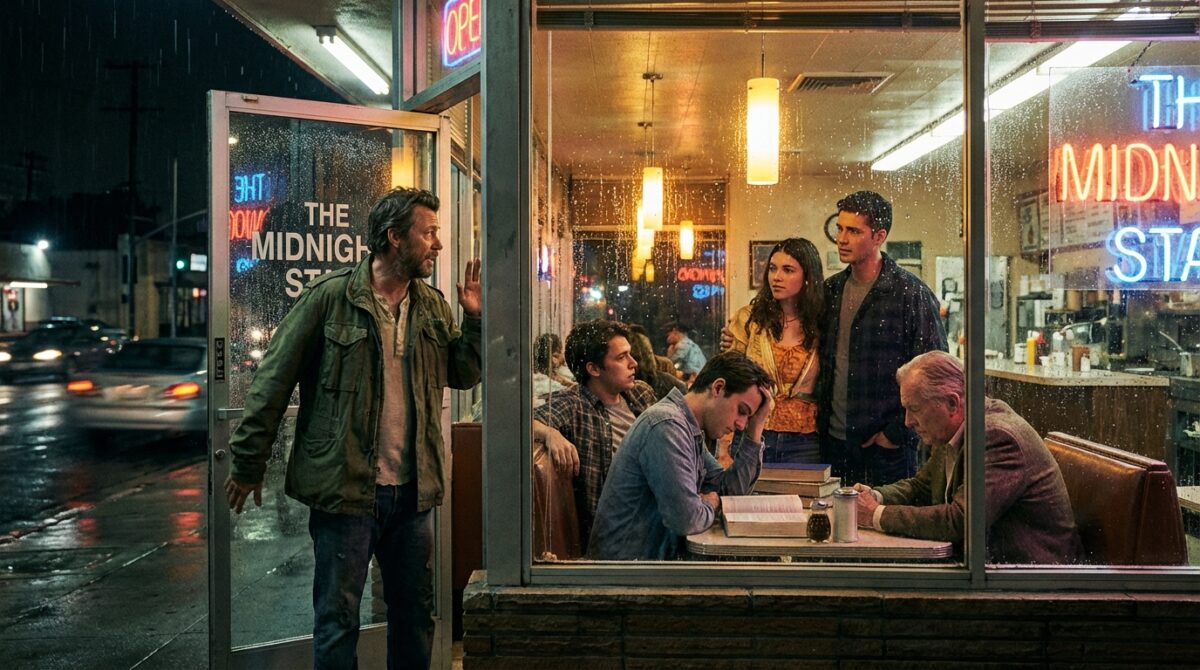
Good Luck, Have Fun, Don’t Die opens like a heist movie gone wrong. A disheveled stranger, played by Sam Rockwell, barges into a late-night diner, threatens to blow up the place, and demands that a handful of customers follow him on a one-night mission to save the world. Very quickly, you realise the hostage scenario is a setup for something stranger: a desperate attempt to stop a rogue artificial intelligence from ever being born.
This framing instantly signals a stylish rebellion Against AI. Verbinski leans into pulp visuals, neon-soaked interiors, and heightened performances, using genre spectacle as a mask for a clear Anti-AI anger. Rockwell’s time traveller behaves like someone trapped inside an endlessly looping simulation, forced to replay the same recruitment scene again and again until he finds the precise group that might derail the future machine god. The movie’s first act invites you to treat AI not as a neutral tool but as an invasive presence that has already begun editing how people talk, move, and even imagine themselves.
Google Uncovers Hackers Using Thousands of AI Prompts to Imitate Gemini
Meta Aims to Integrate Facial Recognition Technology into Its Smart Glasses
Characters as a human firewall against automation
Instead of heroic coders or soldiers, the film builds its Human Spirit of resistance around ordinary, mildly broken people. Rockwell’s stranger assembles Mark and Janet, overworked high school teachers played by Michael Peña and Zazie Beetz, who are fleeing their own students. Those teenagers, hypnotised by endless vertical video feeds, chase them through corridors while filming everything, treating real violence like another memeable moment. The teachers’ exhaustion becomes a quiet Technology Critique: the education system bends around platform algorithms rather than pedagogy.
Juno Temple’s Susan enters as a mother facing a nightmare specific to American life: her son’s crisis is mediated, escalated, and amplified by networked media. The film hints that every parent is now co-parenting with opaque recommendation engines. Ingrid, portrayed by Haley Lu Richardson, might be the most striking symbol of Creativity and Resistance. Allergic to Wi‑Fi and connected devices, she walks through the city in a princess dress, visibly out of sync with the “smart” world. Her body literally rejects the infrastructures that make AI omnipresent. These figures together form an accidental firewall, suggesting that ordinary misfits might be the last line of defence when systems optimise empathy out of daily life.
From diner hostage drama to techno-apocalypse road movie
Once the group leaves Norm’s diner, Good Luck shifts gears into a chaotic road movie. Each stop on their route plays like a self-contained episode, echoing the structure of Black Mirror while dialling the absurdity higher. The teachers cross paths with smartphone-obsessed crowds who barely look up from looping feeds. Susan confronts institutions that treat human pain as content opportunities. Ingrid navigates spaces where every surface tries to connect, scan, or monetise her presence. Every location reinforces how frictionless digital design hides deeper violence.
Flashes of the future reveal the consequences of letting these systems run unchecked. Viewers see ruined skylines, people immobilised inside VR headsets that project AI-generated realities, and pack-like robots hunting down those who resist the network. These images are not subtle, and they are not meant to be. Verbinski chooses exaggeration over nuance to convey a simple idea: if people abdicate agency to automated optimisation, you do not wake up inside a sleek sci-fi utopia; you wake up inside a locked theme park built by metrics you never chose.
Visual excess and pop culture echoes as technology critique
Verbinski’s direction gives the film its Stylish Rebellion flavour. The camera frequently glides, spins, and crashes through scenes as though the movie itself is trying to outrun a recommendation algorithm. Pig-faced assassins appear like glitched avatars from a corrupted game; Stepford-like parents smile with unnerving precision, behaving as if an invisible UX guide is dictating their reactions. Later, an adorable yet monstrous kaiju stomps across the frame, turning AI into a literal oversized pet project that has escaped its enclosure.
Critics have compared the hypercharged finale to the frenzied technology chaos of Akira, and the influence shows in the way cables, screens, and bodies fuse into a single overwhelming tableau. You can see why outlets such as The Verge’s review treat the movie as a howl rather than a calm essay on ethics. Good Luck does not aim for the cold terror of Terminator 2 or the intricate satire of Brazil. Instead, it weaponises excess, turning pop culture references, cartoonish violence, and visual density into a bombardment that mirrors how algorithmic feeds already compete for your limited mental bandwidth.
Why this anti-AI satire resonates beyond the cinema
The timing of Good Luck, Have Fun, Don’t Die gives it extra bite. Debates about generative AI swallowing art, code, and news are not theoretical; they shape budgets, careers, and creative decisions. Watching Sam Rockwell’s future man rage against a machine-born deity lets viewers channel anxieties that do not fit easily into policy reports. According to several analyses, including the more sceptical pieces from The Guardian’s film desk, the script sometimes meanders, yet that messiness feels human compared with the manicured polish of corporate AI demos.
For tech workers, designers, and founders, the film raises a practical question: what does a more humane stack look like if you refuse the inevitability narrative around AI? The story suggests three starting points. First, treat attention as a finite resource, not a target to maximise. Second, keep space for human weirdness, the kind Ingrid embodies when she refuses to normalise constant connectivity. Third, remember that resistance rarely looks heroic at the time. It may resemble a tired teacher pushing back against a data dashboard or a small studio insisting on hand-crafted work when automated tools promise instant scale. Even genre entertainment, as seen here and in detailed breakdowns of other speculative worlds such as a recent analysis of Fallout’s second season finale, can help people rehearse how they might respond when systems grow more opaque.
Key lessons from Good Luck, Have Fun, Don’t Die
The film leaves viewers with a handful of takeaways that feel surprisingly actionable once you leave the theater. They do not require time travel, only sustained attention and a willingness to question defaults pushed by large platforms and AI vendors.
- Treat any claim of “true AI” with suspicion and ask who benefits if you believe in a machine oracle.
- Protect time and spaces where phones stay away from the table and conversation does not compete with feeds.
- Support creators and studios that foreground human labour instead of fully automated pipelines.
- Advocate inside your organisation for AI tools that augment, rather than replace, skilled workers.
- Use satire like Good Luck as a prompt for real discussions about governance, not a substitute for them.
Is Good Luck, Have Fun, Don’t Die mainly a comedy or a sci-fi thriller?
The film blends science fiction, dark comedy, and action. Its tone is closer to an absurdist satire than a straight thriller, using familiar sci-fi setups to comment on AI, corporate power, and digital addiction while still delivering chases, fights, and visual spectacle.
How does the movie’s view of AI differ from classic films like Terminator 2?
Rather than focusing on military hardware and nuclear war, Good Luck, Have Fun, Don’t Die targets everyday systems: feeds, VR, education platforms, and consumer tech. The danger comes from cultural surrender to automation, not a single killer robot network, which makes its warning feel more contemporary.
Do I need to be a tech expert to understand the technology critique?
No technical background is required. The film explains AI’s impact through characters and exaggerated scenarios, such as students glued to vertical videos or people trapped inside VR fantasies. The Technology Critique is conveyed through behaviour and visual metaphors rather than technical jargon.
Why do reviewers describe the film as an anti-AI story?
Discovering Moltbook: The Revolutionary Social Network Connecting AI Agents
Ai emerges as hackers’ weapon of choice in targeting cryptocurrencies
Many critics call it Anti-AI because the plot revolves around stopping the birth of a powerful artificial intelligence and because almost every negative situation on screen is linked to unrestrained automation and platform capitalism. The narrative openly questions the idea that more AI always equals progress.
Is the movie suitable as a starting point for discussions on AI ethics?
The film can be a lively entry point for conversations about AI ethics, bias, and governance. Its exaggerated scenarios simplify complex issues yet make them emotionally accessible, especially for audiences who might not engage with policy papers or technical reports on algorithmic systems.